 ZUFEK
What current supply-chain evidence can and cannot establish
The IEA Global Critical Minerals Outlook 2026 examines mineral markets, supply concentration and resilience. It supports treating material availability and supply-chain structure as real procurement concerns. It does not establish the price of a particular fastener alloy or show that a finished screw order will face a shortage. This article uses the report as broad context and does not turn its market analysis into a forecast for ZUFEK purchasing costs, customer demand or a specific drawing.
A custom-fastener quotation includes much more than raw material. Quantity, tooling, machining, treatment, inspection, packaging and delivery conditions can all matter. A change in one metal market therefore does not translate automatically into the same percentage change in a screw price. Buyers should ask which assumptions have changed and which parts of the quotation are affected. That conversation is more useful than either accepting a broad market explanation without detail or assuming that a supplier’s entire cost should move with one publicly reported commodity indicator.
Establish the approved baseline before comparing alternatives
Collect the actual drawing revision, material designation, delivery condition, finished-property requirements, treatment scope and acceptance records for the approved part. If the baseline is incomplete, an alternative review will inherit that uncertainty. A statement such as “stainless steel” cannot support a careful comparison because it leaves the grade and condition undefined. Similarly, a property class without a clear scope or an old sample without traceable material information may be insufficient to establish what the replacement must preserve.
Identify the functions that depend on the material or its processed condition. These can include mechanical loading, a sliding or locating interface, corrosion requirements, electrical or thermal behaviour, or compatibility with a mating component. The equipment designer should determine which are applicable. The supplier can explain manufacturability and the proposed route, but should not infer every operating requirement from the component name. A good baseline tells the team what must remain unchanged and which features are open to an approved redesign.
Compare delivered conditions, not just grade names
A raw grade designation and a finished fastener requirement describe different things. Heat treatment, forming and finishing can affect the final condition. If an alternative is proposed, compare the state in which each material will be manufactured, treated and delivered. Do not compare a typical value from one material sheet with a minimum acceptance requirement from another specification and call the result equivalence. The basis of the comparison needs to be visible and appropriate to the actual part.
Where a purchaser specifies a finished property requirement, ask how it will be achieved and verified for the proposed route. Where a material condition is itself essential, preserve that condition or obtain explicit approval for a change. A higher nominal strength is not automatically an improvement if it changes ductility, treatment risks or the behaviour of the assembly. Likewise, a corrosion-resistant family name does not establish suitability for every environment. The review must consider the relevant combination of properties and interfaces rather than rank materials on one convenient number.
Include manufacturability in the alternative review
An alternative material may change which forming or machining operations are practical. Features that were economical in one condition may need a different tool, process sequence or allowance in another. Discuss the head, shoulders, holes, thread and any difficult transitions with the supplier. Ask whether the proposed material changes the route, cycle, tooling scope or inspection approach. A nominal material saving can disappear if it introduces more demanding secondary operations or reduces the range of feasible production options.
This does not mean that a familiar route must never change. A different route can be a sensible response when the geometry and approved requirements support it. The important point is to review the delivered result and the evidence rather than assume that route changes are invisible to the customer. If a formed blank becomes a fully machined part, or a turned sample becomes a formed production part, identify which characteristics and records need renewed approval. Keep the route proposal connected to the drawing instead of treating it as a purely internal purchasing decision.
Reassess surface treatment and final dimensions
A material substitution can change the appropriate preparation or treatment route. The customer should review corrosion protection, friction requirements, appearance where specified and any treatment-related risks against the alternative material and condition. Avoid transferring a coating name mechanically from the old drawing without checking the intended result. If a required treatment is unavailable or unsuitable for the proposal, that is a design-review issue, not a detail to conceal behind a similar colour.
Dimensional acceptance should refer to the final delivery condition. A close-fitting shoulder or a thread may be sensitive to treatment scope and allowance. If the alternative route changes the order of machining, heat treatment and finishing, review how the final dimensions will be achieved and checked. An inspection report before the last relevant operation cannot establish every final characteristic. Ask the supplier to identify the proposed sequence at a level sufficient to explain the critical interfaces, while leaving routine process details to the agreed manufacturing responsibility.
Avoid automatic cross-standard equivalence claims
Material names from different national or industry systems can look similar without being interchangeable for a particular drawing. A responsible comparison needs the relevant composition, condition, properties, product form and acceptance basis. A web table showing an approximate counterpart can help identify a candidate for review; it does not approve the candidate. The purchaser’s engineering authority should determine what evidence is needed and whether the drawing or specification must be revised.
If a supplier proposes an alternative reference, ask for its exact designation and applicable edition or basis. Record differences and unresolved points. Do not quietly substitute the closest familiar name on the material certificate or order acknowledgement. This is especially important when a customer’s part is shared across programmes with different documentation requirements. A part that is acceptable for one assembly may not be approved for another merely because the original internal part number was reused. Keep approval scope visible in both the technical and purchasing records.
Build a qualification plan before an urgent shortage
An alternative strategy works better when candidates are reviewed before an order is at risk. Identify which parts are commercially important, which have difficult material or treatment dependencies and which have plausible alternative routes. Prioritise the candidates that can be meaningfully evaluated with available assembly information. A list of alternate grades with no sample plan or approver can create false confidence, because the hard decisions will still have to be made under time pressure.
For each candidate, define the comparison questions, required documents, sample condition and acceptance checks. Some reviews may be resolved through specification and manufacturing evidence; others may require appropriate component or assembly evaluation. Agree who will perform and approve those checks. Do not claim a test result that has not been obtained. Once an alternative is accepted, record its permitted use and whether it is a permanent drawing option, a limited deviation or a proposal that still requires release for each order.
An illustrative shoulder-screw material change
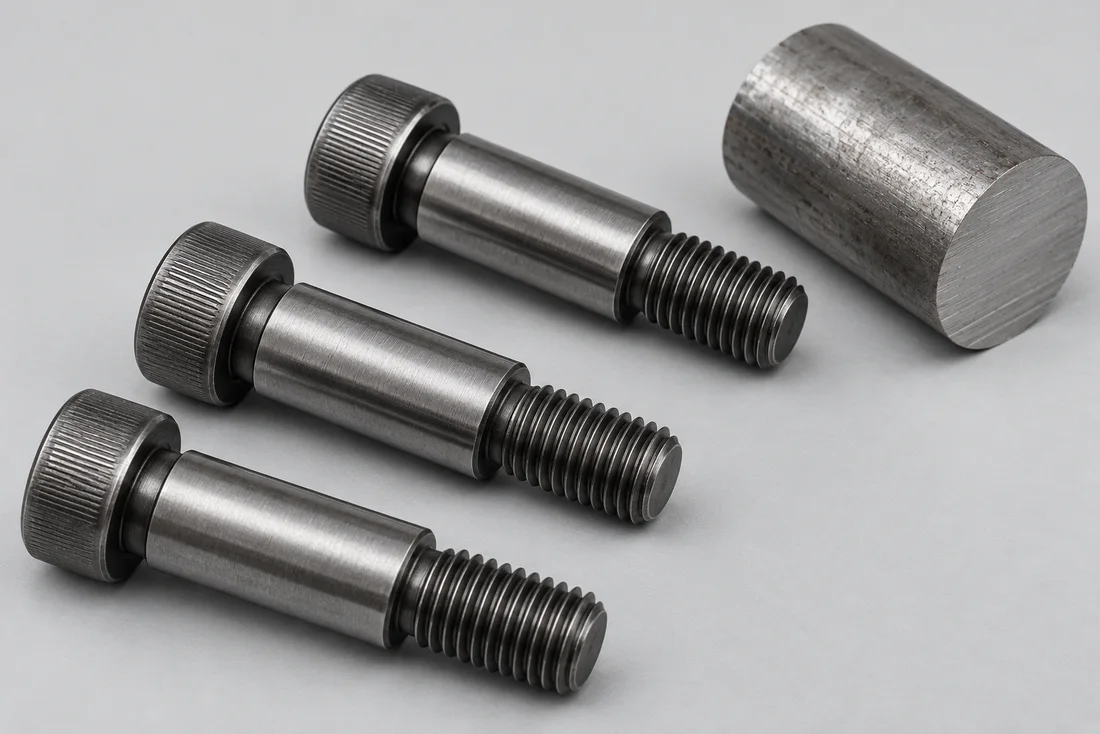
Consider a custom shoulder screw used in a positioning mechanism. The buyer wants an alternative because the originally specified material condition has an uncertain delivery date. This is a design-review exercise, not a customer case. The first step is to identify what the approved part must do: maintain a defined shoulder fit, provide the required threaded retention and meet the specified final material and surface condition. A replacement cannot be approved solely because its catalogue lists a similar nominal strength.
The proposed alternative changes the machining and treatment plan. The team reviews whether the shoulder will still reach its accepted final condition, whether the surface interaction with the mating bore needs evaluation and what records will identify the supplied lot. If a geometry or finish change is proposed, it is submitted for approval rather than hidden within the substitution. The example deliberately does not choose a universally superior grade. Its purpose is to show how the functional interface guides the alternative review and prevents a purchasing urgency from becoming an unrecorded design change.
Compare the total cost of a controlled alternative
Ask suppliers to separate the effects of material, tooling, secondary operations, treatment, inspection and packaging where those distinctions are relevant to the decision. Include sample qualification and any additional documentation that the alternative requires. A cheaper raw material can increase total programme cost if it needs a more demanding route or a new approval cycle. A more expensive material can also be unnecessary if its added properties do not address any requirement of the assembly.
Timing has a cost structure too. An alternative that can be produced quickly may still require customer evaluation before it can be used. Distinguish manufacturing availability from approval readiness. Record which milestones are on the supplier’s side and which depend on the purchaser. An honest comparison includes the uncertainty of the qualification work. It does not treat a provisional sample date as the confirmed delivery date of an approved production part. This makes the decision understandable to engineering, purchasing and production planning rather than leaving each team to interpret the quotation differently.
Preserve traceability when both versions remain active
If the approved original and alternative can both be ordered, define how they will be identified. Depending on the programme, this may involve separate part numbers, drawing options, revision references or controlled deviations. Choose an arrangement that makes it possible to connect delivered parts with the actual material and finish condition. Do not rely only on a purchaser remembering which option was discussed in an email. The identification needs to survive order entry, packaging, receipt, stores handling and any split delivery.
Where variants look alike, review whether the packaging and records prevent unintended mixing. Decide what the customer needs to retain after the parts leave the original container. If a supplier later changes its own source or route, define the notification expectation. Traceability should help answer a practical question: which parts are installed or available, under which approved condition, and what supporting evidence belongs to them? A record that cannot support that question may be administratively complete but operationally weak.
Turn the alternative into a controlled release
Before releasing an alternative, close the review record. Confirm the drawing or deviation status, the approved route and delivery condition, the completed checks, the permitted applications and the required lot documentation. Identify any remaining limitation, such as approval for a prototype build only. Communicate the outcome to the teams that place repeat orders and use spare parts. An approval known only to the original engineer can be lost when the next buyer compares quotations or changes an order quantity.
Schedule a review when the underlying assumptions change. A substantial quantity shift, a different treatment requirement or an altered mating assembly can justify revisiting the selected route or alternative. That is a more useful approach than assuming every approval remains valid indefinitely. Supply resilience comes from a maintainable set of engineering options, not from removing all constraints from a purchase order. The constraints that preserve function and evidence are precisely what make an alternative dependable.
Questions to send with the next RFQ
Ask for the exact material and condition, the proposed route, the final treatment basis, the features affected by substitution, the documents available and any exceptions to the drawing. Provide the quantity pattern, the intended assembly and the acceptance requirements. State whether alternatives are welcome and who can approve them. If none are permitted, say so clearly; if they are permitted, define the review process rather than inviting silent substitution.
Current mineral-market discussions make supply risk visible, but the response at fastener level must remain specific. A buyer can improve continuity by establishing the approved baseline, identifying plausible candidates and qualifying them against the actual interface. A manufacturer can contribute by making route assumptions and evidence limits explicit. Together, those practices create options that are technically reviewable and commercially comparable. That is a stronger basis for resilience than treating every material with a familiar name as interchangeable when a delivery date becomes inconvenient.
Sources and scope
Source context is distinguished from ZUFEK editorial analysis. Examples are illustrative, not delivered customer cases or measured test results. Check the applicable current specifications for your product.