
 ZUFEK
Titanium & Titanium Alloys
Titanium grades are considered where mass, corrosion exposure and required mechanical properties justify a grade-specific manufacturing and verification plan.
Strength reference
Commercially pure Grade 2 and Ti-6Al-4V are different materials. Grade, product form and condition must accompany any strength value.
| Grade / condition / basis | Tensile strength Rm (MPa) | Yield / 0.2% stress (MPa) | Scope of the reference |
|---|---|---|---|
| Ti-6Al-4V annealed material example | 895 minimum | 828 minimum | Titanium Engineers annealed stock reference; size, condition and heat treatment affect properties. Confirm the ordered product specification. |
| CP Titanium Grade 2 reference | Confirm the specified product | 275 minimum yield reference | Carpenter Grade 2 reference; not a Ti-6Al-4V equivalent. |
Values refer to the stated material or fastener-class basis. They are not a certified property or load rating for every ZUFEK custom geometry. Confirm the applicable specification and test condition for the ordered part.
Compare grades and delivery conditions
A material family is a starting point, not a complete specification. The following options are selection references; supply and suitability require drawing review.
| Grade or specified condition | What distinguishes it | When to consider it | What to confirm before ordering |
|---|---|---|---|
| Grade 2 — commercially pure titanium | Specify product form and supplied condition. | Corrosion-driven components where its mechanical properties meet the design. | Not mechanically interchangeable with Ti-6Al-4V. |
| Grade 5 — Ti-6Al-4V | An alloy grade with a different strength and processing basis. | Weight-sensitive loaded components where the complete specification justifies it. | State condition and acceptance; titanium does not imply aerospace qualification. |
| Grade 23 — Ti-6Al-4V ELI | Extra-low-interstitial variant with a distinct specification. | Consider only when the drawing or application requires this variant. | Not automatic medical approval; traceability and application qualification are separate requirements. |
How to narrow the choice
First decide whether commercially pure titanium or an alloy is needed. Then specify the exact grade, product standard, condition, surface requirements and verification. Review thread galling and mating surfaces during assembly planning.
Write an unambiguous material requirement
Include the designation standard, exact grade, product form, delivery condition, final mechanical requirements, surface treatment and acceptance evidence. Similar names across EN, ASTM, SAE, JIS or GB systems are comparison leads, not permission to substitute.
If the grade is not yet decided, send the load or locating function, environment, mating materials, quantity and drawing. Ask for a proposed grade and route with stated assumptions before approving the material.
The listed grades are comparisons for drawing review, not a declaration that every grade, size or treatment is held in stock. Availability, route and ordered evidence are confirmed in the quotation.
Selection, processing and acceptance
Choose the grade and condition together with the job the screw performs. The following checks connect the material shortlist to manufacturing and sample acceptance.
- Function and grade choice
- Choose commercially pure Grade 2 when its corrosion and mechanical balance suits the duty; compare Grade 5 when the design calls for an alloy-strength route. Grade 23 ELI has its own interstitial limits and specification. Selecting it does not by itself approve a medical or aerospace component.
- Processing and final dimensions
- Grade and condition affect cutting, tool wear and treatment planning. Review the final thread and bearing interfaces for galling, and specify compatible lubrication or surface treatment where needed. Do not import a steel tightening torque or heat-treatment instruction into a titanium drawing without an assembly-specific review.
- What the sample must demonstrate
- State product standard, grade, condition and required lot traceability. Keep stock property records separate from final dimensions and any ordered mechanical tests. If mass, fatigue, corrosion or repeated adjustment drives the choice, define how that function will be verified in the actual geometry and assembly.
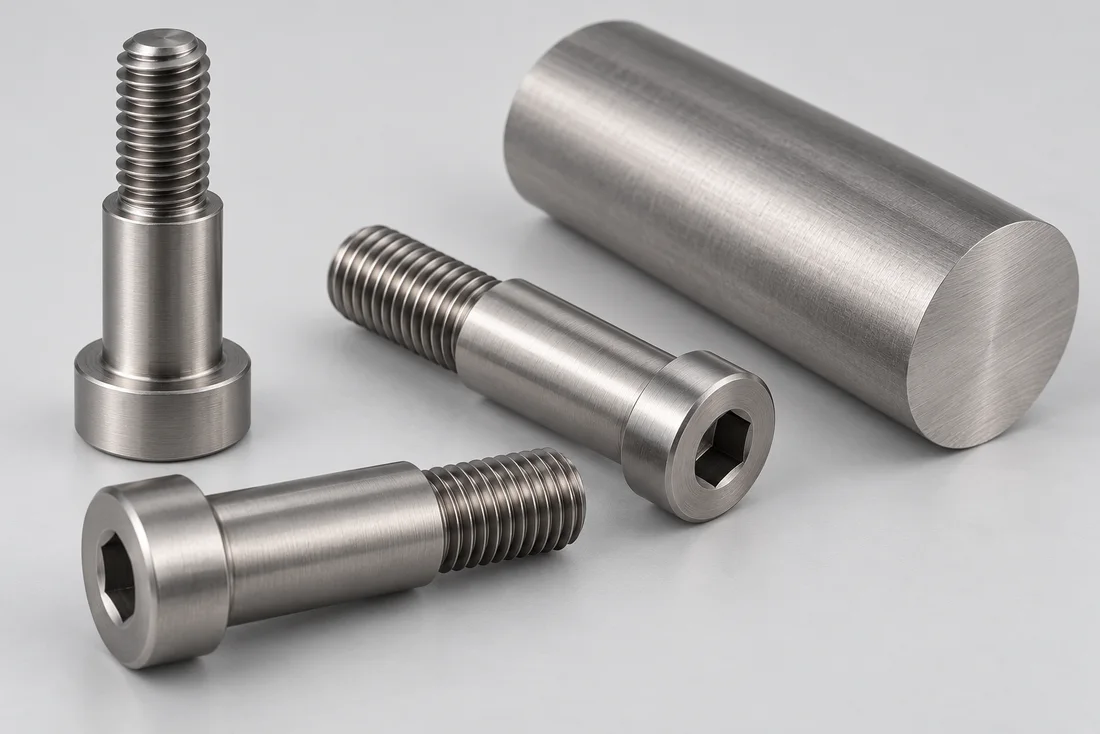
Example: an annealed Grade 5 precision shoulder
For a mass-sensitive assembly with specified mechanical requirements, compare titanium grades on their actual condition and product specification before defining the final joint checks.
Illustrative material request. Drawing-specific limits and acceptance criteria remain to be agreed; this is not a released design or a ZUFEK test result.
- Grade and supplied condition
- Grade 5 Ti-6Al-4V bar in the agreed annealed condition, with product specification, stock size and lot identity recorded.
- Finished-part requirement
- Define the finished mechanical and geometric requirements separately. Stock material properties do not establish the strength of a reduced shank or threaded connection.
- Surface and mating interface
- Specify shoulder fit, thread engagement, mating metals and the agreed surface or lubrication system. Include galling and service access in the assembly review.
- Acceptance records
- Agree material and condition records, traceability and the required finished-part checks; specify any application qualification separately.
- Alternative to review, not assume
- Grade 2 is commercially pure titanium; Grade 23 ELI has a distinct specification. Neither is an automatic substitute for the approved Grade 5 requirement.
Material selection questions
Can Grade 2 and Grade 5 use the same strength value?
No. Grade 2 is commercially pure titanium; Grade 5 is Ti-6Al-4V. Compare the specified product form and condition and use the appropriate property basis for each.
Does Grade 23 ELI mean the screw is medically approved?
No. ELI identifies a material variant. Application qualification, manufacturing controls, traceability and acceptance of the finished device remain separate requirements.
Why consider this family?
- Useful strength-to-mass considerations for suitable grades
- Corrosion-driven material selection in appropriate environments
- Custom turned features can be evaluated against the specific grade
Application range
Lightweight equipment, optical and precision assemblies, and selected corrosion-exposed custom connections.
Selection and process considerations
A titanium label does not imply an aerospace or medical qualification. Review grade, final condition, thread galling, surface treatment, mating metals and verification. Exact mechanical and traceability requirements need agreement before production.
Include in the RFQ
- Exact titanium grade and condition
- Required mechanical properties
- Surface and assembly requirements
- Traceability and verification scope
Related products and manufacturing routes
Relevant application discussions
Choose material and finished strength together
Use a common set of functional, environmental and acceptance requirements before comparing grades and conditions. Separate material stock figures from finished fastener classes and assembled joint performance.
Follow the material and strength selection workflow ↗Connect the part to its requirements.
Review these related topics for this design or route. Grade, treatment, geometry and acceptance remain drawing-specific.
Choosing material for a custom metal screw ↗
Material selection begins with the service environment and mechanical requirements. The best specification balances function, manufacturability, availability and verification.
ENGINEERING GUIDEFirst-article approval for custom screws: a practical handoff ↗
A sample is most useful when its identity, revision and acceptance scope are clear. First-article planning connects the approved drawing with the evidence needed before the next production decision.
Discuss titanium & titanium alloys for your drawing.
Share your drawing, quantity and application requirements with our team.